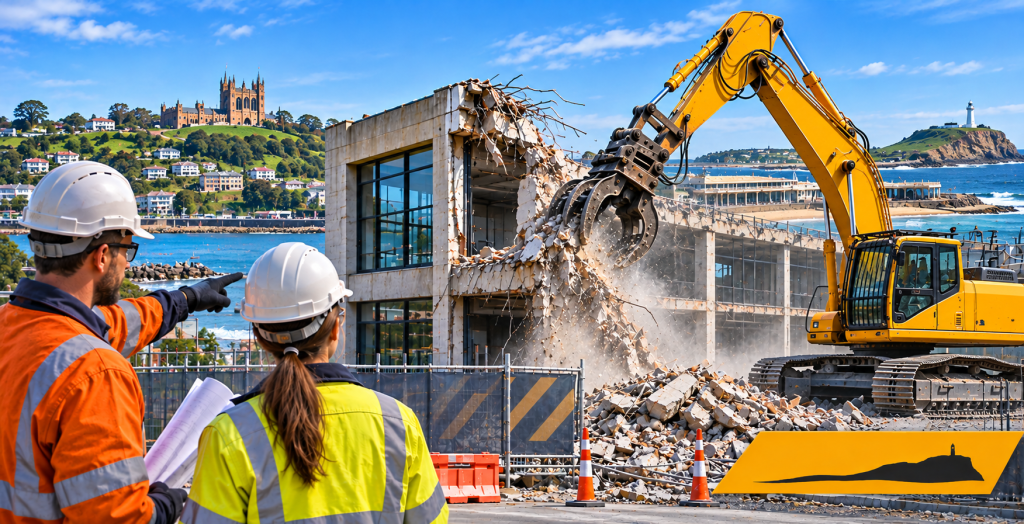
Commercial demolition is not simply a matter of bringing in an excavator and knocking down an old building.
Whether you’re clearing a warehouse, removing an ageing office building, demolishing a retail premises or preparing an industrial site for redevelopment, there’s considerable planning involved before the first wall comes down.
For property owners, developers and builders across Newcastle, Lake Macquarie and the Hunter Region, getting that planning right can make the difference between a well-managed demolition project and one affected by delays, unexpected costs and safety concerns.
Commercial demolition involves more than removing a structure. It requires an understanding of the building, surrounding properties, underground services, hazardous materials, regulatory requirements and what needs to happen once the site has been cleared.
At CUB Projects, we understand that demolition is often just the first stage of a much larger construction or redevelopment project.
Here’s what property owners and developers should consider before undertaking commercial demolition in Newcastle.
Commercial Demolition Starts With Understanding the Site
Every commercial demolition project is different.
Demolishing a small standalone commercial building is not the same as removing a multi-storey office, a warehouse with adjoining structures or an industrial facility that has operated for decades.
Before determining how a building should be demolished, the contractor needs to understand what they’re dealing with.
That means assessing:
- The building’s construction type, age and structural condition.
- Whether neighbouring buildings share walls or structural connections.
- Access for excavators, trucks and other demolition equipment.
- Underground and overhead services.
- Potential asbestos and other hazardous materials.
- Nearby businesses, pedestrians and vehicle movements.
- Existing drainage and underground infrastructure.
- Any structures or building components that must remain.
Previous uses of the property can also reveal potential problems.
For example, an old industrial workshop may have underground fuel tanks, contaminated soil or chemical storage areas. A commercial building constructed before the widespread phase-out of asbestos products may contain asbestos in roofing, wall linings, flooring or service areas.
Identifying these issues early helps determine the appropriate demolition method, equipment, safety controls and project programme.
And importantly, it reduces the likelihood of expensive surprises once work begins.
What Approvals Are Required for Commercial Demolition in Newcastle?
One of the first questions property owners should establish is whether their proposed demolition requires development consent.
In NSW, some demolition work may qualify as complying development, provided it satisfies the relevant planning standards and eligibility requirements.
Other projects require a Development Application (DA) and approval from the relevant consent authority.
For commercial demolition in Newcastle, the approval pathway can depend on factors including the building’s location, size, heritage status, environmental constraints and the nature of the proposed work.
A property owner should not assume that demolition is automatically permitted simply because the building is privately owned or no longer being used.
The NSW Planning Portal’s demolition guidance explains the complying development pathway and associated requirements.
For sites within Newcastle, the City of Newcastle is also an important starting point for local planning requirements.
The practical advice is straightforward: establish the applicable approval pathway before committing to demolition dates or arranging construction work that depends on the site being cleared.
Demolition Licensing, Notifications and Workplace Safety
Commercial demolition is a high-risk activity, particularly when structural elements are being removed or heavy machinery is operating close to neighbouring properties.
In NSW, demolition work must comply with applicable work health and safety legislation.
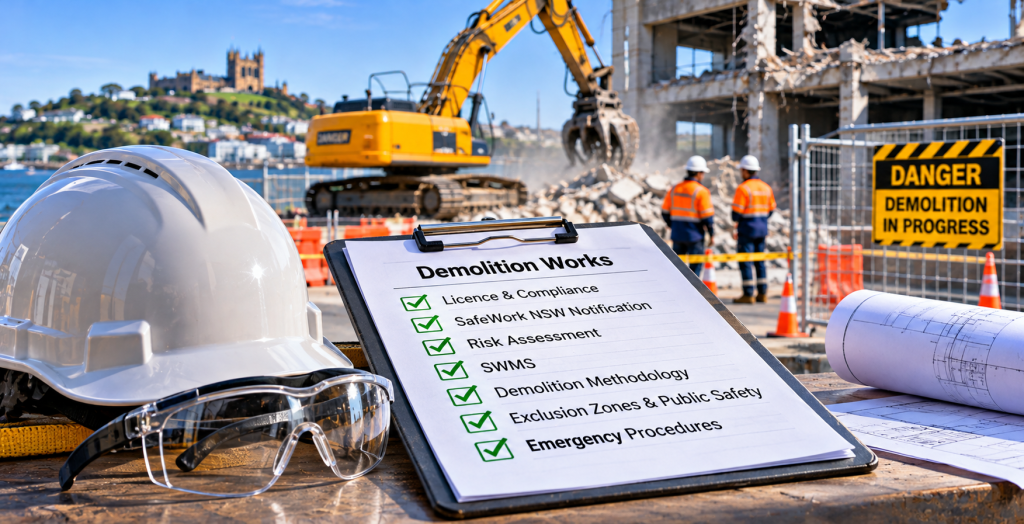
Depending on the work involved, requirements can include:
- Appropriate demolition licensing.
- SafeWork NSW notifications.
- Site-specific risk assessments.
- Safe Work Method Statements (SWMS) for high-risk construction work.
- Suitable demolition methodology.
- Competent operators and appropriately trained workers.
- Exclusion zones and public protection.
- Structural stability controls.
- Emergency procedures.
Not every demolition project requires the same class of licence. The licensing requirements depend on the nature and scope of the work.
For certain licensed demolition activities, SafeWork NSW must receive notification at least five calendar days before the work begins.
The SafeWork NSW demolition guidance provides information on the applicable safety requirements.
For property owners, verifying a contractor’s licensing and experience should be part of the selection process.
We’ve covered this in greater detail in our article, Choosing a Demolition Contractor in Newcastle: What Property Owners and Developers Should Look For.
A contractor should be able to explain how the work will be undertaken safely, not simply provide a price for removing the building.
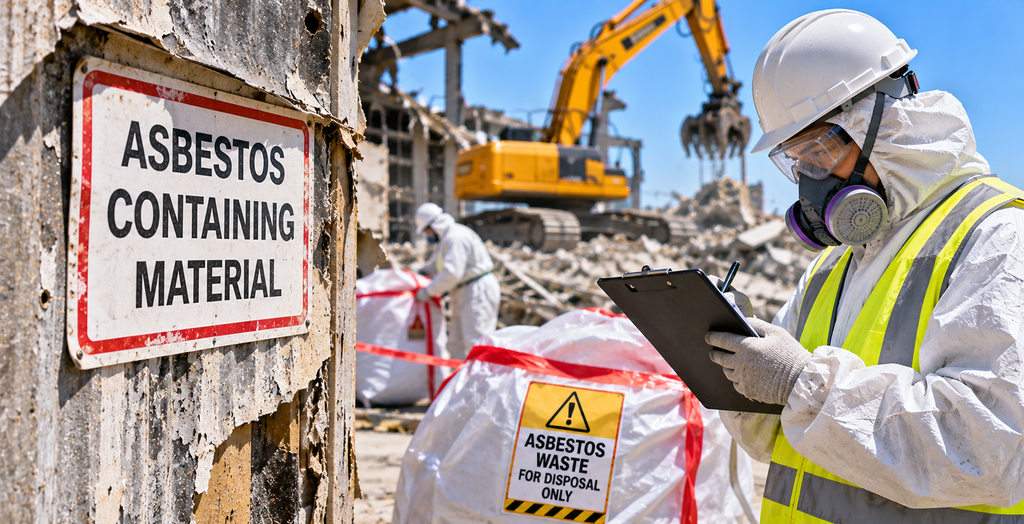
Check for Asbestos and Hazardous Materials Before Demolition
Asbestos remains an important consideration when demolishing older commercial and industrial buildings throughout Newcastle and the Hunter Region.
Depending on the building’s age and construction, asbestos-containing materials may be present in roofing, external cladding, wall sheeting, floor coverings, insulation and other components.
Other potential hazards include lead-based paint, chemical residues, contaminated soil and redundant fuel or chemical storage systems.
These materials can affect how demolition is planned and carried out.
Before demolition begins, asbestos must be identified and managed in accordance with NSW requirements. Where asbestos removal is necessary, it must be completed before demolition work that could disturb the material, subject to the limited exceptions provided by the applicable regulations.
SafeWork NSW provides guidance on identifying asbestos hazards, removal requirements and appropriate controls.
For a detailed explanation of what Newcastle property owners should expect, read our recent article:
Asbestos Removal Newcastle: Costs, Process and Safety Requirements.
We also explain the broader risks associated with asbestos in Asbestos Safety: What Property Owners Need to Know.
The important point is that hazardous material identification should be part of the initial demolition planning, not something left until machinery is already on site.
Disconnecting Services Before Commercial Demolition
A building may appear vacant, but that doesn’t necessarily mean its services have been disconnected.
Commercial properties can have complicated electrical installations, gas connections, telecommunications infrastructure, water supply, sewerage and stormwater systems.
Some industrial properties may also have specialist services or underground infrastructure associated with previous operations.
Before demolition begins, the relevant services need to be identified and appropriately isolated, disconnected, protected or otherwise managed.
This can involve coordination with utility providers and suitably qualified tradespeople.
Underground services are particularly important when demolition is followed by excavation or civil construction.
Damaging an unidentified service can create serious safety risks, disrupt neighbouring properties and delay the project.
The national Before You Dig Australia service provides an important starting point for identifying registered underground infrastructure.
Our earlier article, Essential Services in Civil Construction, explains why managing infrastructure is an important part of construction and site development.
Choosing the Right Demolition Method and Sequence
There is no single demolition method suitable for every commercial building.
The most appropriate approach depends on the structure, its condition, available space, surrounding properties and what must remain after demolition.
For example, a standalone warehouse with clear access may allow a different demolition approach from a commercial building positioned between occupied premises.
Depending on the project, demolition may involve mechanical demolition, controlled dismantling, selective demolition or a combination of methods.
The demolition sequence is particularly important.
Removing the wrong structural element at the wrong time can compromise the stability of the remaining building.
The NSW Demolition Work Code of Practice addresses structural stability, planning, exclusion zones and other safety considerations.
A properly developed demolition methodology should account for:
- The order in which structural components will be removed.
- How the remaining structure will remain stable.
- Where demolition plant will operate.
- How falling materials will be controlled.
- How workers and the public will be protected.
- How debris will be removed from the site.
- Whether temporary supports or additional engineering assessments are required.
This is why commercial demolition should be approached as an engineered and managed construction activity, rather than simply a machinery operation.
Managing Dust, Noise, Traffic and Neighbouring Properties
Commercial demolition can affect more than the property being demolished.
Depending on the location, surrounding businesses may remain open, pedestrians may use nearby footpaths and delivery vehicles may need access to neighbouring premises.
In established commercial areas of Newcastle, these considerations can be particularly important.
Dust, noise, vibration and truck movements need to be addressed through suitable site controls and project planning.
Depending on the site, this may involve:
- Dust suppression during demolition and material handling.
- Fencing, barriers and exclusion zones.
- Traffic management arrangements.
- Controls for vehicle entry and exit.
- Managing noise and vibration.
- Protecting neighbouring structures.
- Scheduling disruptive activities appropriately.
- Maintaining safe pedestrian access where required.
For developers, these measures are not simply about meeting safety obligations.
They also help reduce disruption, complaints and the risk of work being interrupted.
What Happens to Commercial Demolition Waste?
Once a commercial building is demolished, there can be substantial quantities of material to manage.
Concrete, bricks, steel, timber, plasterboard, fixtures and other building materials may all require different handling and disposal arrangements.
Some materials can be separated for recycling or recovery, while others must be taken to appropriately authorised facilities.
Hazardous materials require additional controls and cannot simply be mixed with general demolition waste.
Waste management should therefore be considered before demolition begins.
Planning the separation, storage, loading and transport of demolition materials can improve site efficiency and help avoid unnecessary handling.
For larger commercial projects, this can also affect truck movements, disposal costs and the overall demolition programme.
We’ve previously explored these issues in Sustainable Practices and Innovations in Demolition Waste Management, including the opportunities for concrete recycling, metal recovery and improved material separation.
The key consideration is that demolition waste management forms part of the project, not an afterthought once the building is down.
Demolition Should Be Planned Around What Happens Next
For most commercial property owners and developers, demolition is not the final objective.
The site may be required for a new commercial building, industrial development, residential project or other form of redevelopment.
That means the demolition contractor needs to understand what condition the site must be left in.
Depending on the project, subsequent work may involve:
- Bulk excavation and earthworks.
- Removal of redundant foundations.
- Site remediation.
- Drainage and stormwater infrastructure.
- New underground services.
- Retaining structures.
- Civil construction and site preparation.
Planning these activities together can reduce duplicated work and unnecessary mobilisation of machinery.
For example, if excavation is scheduled immediately after demolition, the demolition methodology and final site condition should be coordinated with the excavation requirements.
Similarly, understanding the location of existing foundations and underground services can help avoid unexpected complications during the next construction stage.
Our article on Innovative Civil Construction Technology discusses how technology and improved construction practices can contribute to better project delivery.
The objective should be to prepare the site for its next use, not simply remove what is currently standing on it.
What Can Delay a Commercial Demolition Project?
Commercial demolition delays are not always caused by problems with machinery or the physical demolition work.
Often, the biggest setbacks arise from issues that could have been identified during planning.
Common examples include:
- Development approvals not being finalised.
- Asbestos or other hazardous materials being discovered unexpectedly.
- Utility disconnections taking longer than anticipated.
- Restricted access for demolition equipment.
- Unidentified underground infrastructure.
- Concerns about neighbouring building stability.
- Additional environmental or waste disposal requirements.
- Changes to the redevelopment programme.
Some of these issues are unavoidable, particularly on older sites where building records are incomplete.
However, early inspections, appropriate investigations and coordination between the property owner, demolition contractor and other project participants can reduce the likelihood of delays.
And when unexpected conditions do arise, having a clear process for assessing and managing them is far better than making rushed decisions on site.
Planning Commercial Demolition in Newcastle
Commercial demolition is an important stage in many redevelopment and construction projects across Newcastle, Lake Macquarie and the Hunter Region.
Whether the project involves a warehouse, office, retail building or industrial facility, the same principle applies: successful demolition starts with proper planning.
Understanding the building, confirming approvals, identifying hazardous materials, managing services and coordinating the work with the next stage of construction all contribute to a safer and more efficient project.
For property owners and developers, choosing an appropriately experienced demolition contractor is an important part of that process.
Planning a commercial demolition project in Newcastle?
Contact CUB Projects to discuss your site, demolition requirements and the work needed to prepare your property for its next stage.
Frequently Asked Questions About Commercial Demolition in Newcastle
1. How much does commercial demolition cost in Newcastle?
The cost of commercial demolition depends on the size and construction of the building, site accessibility, hazardous materials, demolition methodology and waste disposal requirements.
A small standalone commercial building will generally involve different costs from a large industrial warehouse or multi-storey structure.
Asbestos removal, service disconnections, restricted access and the removal of substantial concrete foundations can also affect the final price.
The most reliable approach is to arrange a site assessment and request a detailed quotation based on the actual demolition requirements.
2. Do I need council approval to demolish a commercial building in Newcastle?
In many cases, yes. Commercial demolition generally requires an appropriate planning approval pathway, although some work may qualify as complying development under NSW planning legislation.
Whether a Development Application or Complying Development Certificate is required depends on the property, applicable planning controls and the proposed work.
Heritage restrictions and environmental constraints can also affect eligibility.
Check with City of Newcastle or an appropriately qualified planning professional before commencing demolition.
3. Does a commercial demolition contractor need to be licensed in NSW?
Certain demolition activities require a restricted or unrestricted demolition licence issued or recognised by SafeWork NSW.
The licence required depends on the nature of the structure and the demolition work involved.
Contractors must also comply with applicable WHS obligations, including requirements for competent workers, safe work procedures and notifications where relevant.
Property owners should verify licensing rather than relying solely on a contractor’s claims. SafeWork NSW+1
4. What happens if asbestos is found before demolition?
Suspected asbestos must be assessed and appropriately managed before demolition work that could disturb it proceeds.
Depending on the type and quantity of asbestos, removal may require a licensed asbestos removalist and notification to SafeWork NSW.
The asbestos must also be packaged, transported and disposed of in accordance with applicable requirements.
Read our guide to Asbestos Removal in Newcastle for further information.
5. How long does a commercial demolition project take?
The timeframe varies considerably depending on the building, approvals, site conditions and scope of work.
The physical demolition of a relatively straightforward structure may take days, while larger or more complicated commercial projects can require several weeks or longer.
However, the overall programme must also allow for planning approvals, inspections, hazardous material removal, service disconnections, demolition notifications and waste removal.
A realistic demolition schedule should account for these activities before work begins.
6. Can demolition, excavation and site preparation be managed as one project?
Yes. Depending on the contractor’s capabilities, licensing and project requirements, demolition, excavation and associated civil works can be coordinated as part of a broader project.
This can be particularly useful when an existing commercial building is being removed to make way for redevelopment.
Coordinating these activities early can reduce duplicated site preparation, improve scheduling and help ensure the site is left in the condition required for the next construction stage.
References and Sources
The following government and industry resources support the article’s regulatory and technical content.
1. SafeWork NSW, Demolition. Workplace safety, demolition hazards and regulatory responsibilities.
2. SafeWork NSW, Demolition Work Code of Practice (PDF). Demolition planning, structural stability, site controls and demolition methodology.
3. SafeWork NSW, Demolition Notifications. Notifiable demolition activities and the five-calendar-day notification requirement.
4. SafeWork NSW, Working as a Demolition Licence Holder. Licensing, safe work procedures and demolition planning.
5. NSW Planning Portal, Demolition. Complying development eligibility, planning standards and conditions.
6. Before You Dig Australia. Underground infrastructure enquiries before excavation and demolition.
7. SafeWork NSW, Structural Collapse Incident, August 2026. A recent example highlighting the importance of structural stability, demolition sequencing and public protection.