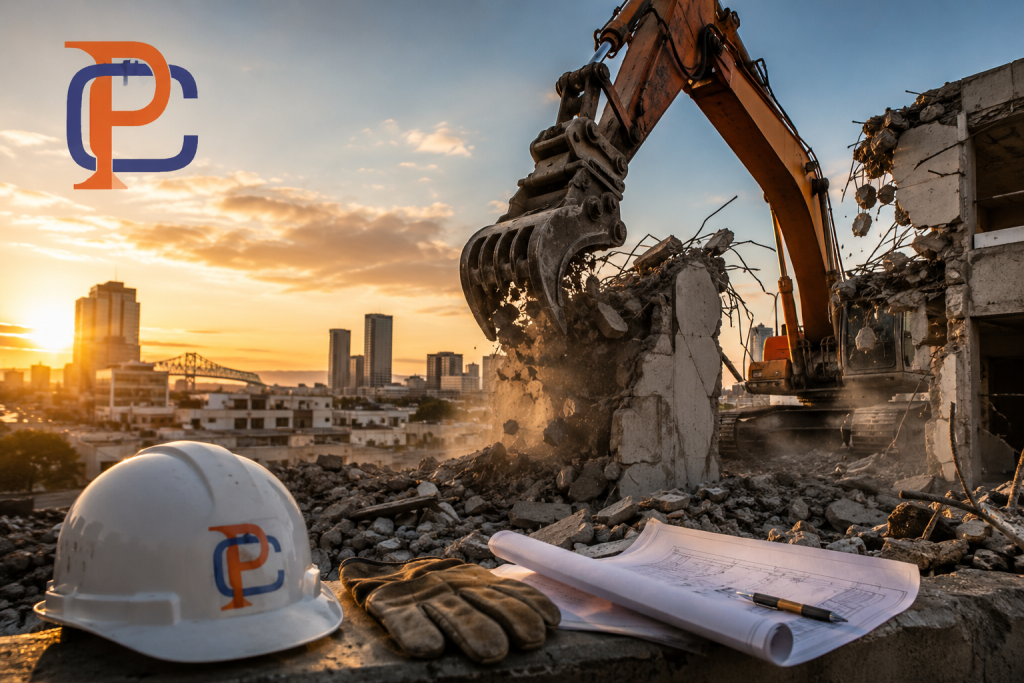
Choosing a demolition contractor can look fairly straightforward from the outside. Get a few quotes, compare the numbers and appoint someone to knock the building down.
In practice, there is considerably more to it.
Demolition is classified as high-risk construction work in NSW, and the contractor you appoint may be responsible for managing structural hazards, heavy machinery, asbestos and other hazardous materials, neighbouring properties, waste removal, site security and the condition of the land handed back at the end of the job.
For property owners, builders and developers comparing demolition contractors in Newcastle, price matters, but it should be only one part of the decision.
A properly planned demolition project starts well before the excavator turns up.
1. Check the Contractor’s Demolition Licence and Credentials
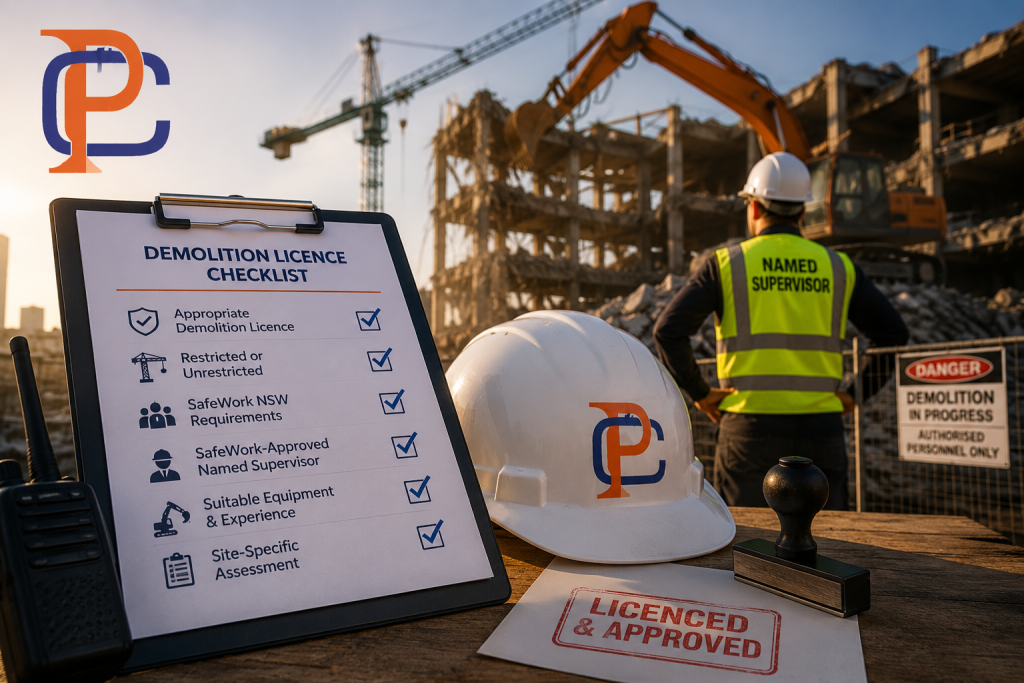
One of the first questions to ask is simple: what demolition licence does the contractor hold, and is it appropriate for your project?
SafeWork NSW identifies two types of demolition licence, restricted and unrestricted.
A restricted demolition licence applies to certain demolition involving load-bearing or structurally important parts of structures between 6 and 15 metres high, as well as particular work involving load-shifting machinery on suspended floors.
An unrestricted demolition licence covers more complex demolition, including relevant structures over 15 metres high and work involving circumstances such as tower cranes, large mobile cranes, floor propping, certain pre-tensioned or post-tensioned structural components, chemical installations or explosives.
The important point for a client is that not every demolition project is the same.
Don’t simply ask whether a company “does demolition”. Establish whether its licence, supervision, equipment and experience are suitable for your particular structure and site.
SafeWork NSW also requires a SafeWork-approved named supervisor to be on site supervising licensed demolition work.
2. Look for Relevant Project Experience
Years in business can tell you something about a demolition contractor, but relevant experience tells you more.
Demolishing a detached residential property is quite different from taking down a commercial building, industrial structure, warehouse or complex reinforced-concrete structure.
Access can also change the job substantially.
A relatively simple building can become a much more complicated demolition project when it sits beside occupied premises, has restricted machinery access, contains hazardous materials or requires demolition to occur alongside other construction or civil works.
Ask prospective contractors about comparable projects they have completed.
What type of structure was involved? How was the demolition undertaken? What complications arose? How were neighbouring properties, waste and site access managed?
As we discussed previously in From Wrecking Balls to Precision Implosions: Navigating Demolition Methods, Regulations and Sustainability in Australia, modern demolition involves considerably more planning and precision than simply bringing a structure down.
3. Safety Should Be Obvious Before Work Starts
You shouldn’t have to wait until demolition begins to find out how seriously a contractor takes safety.
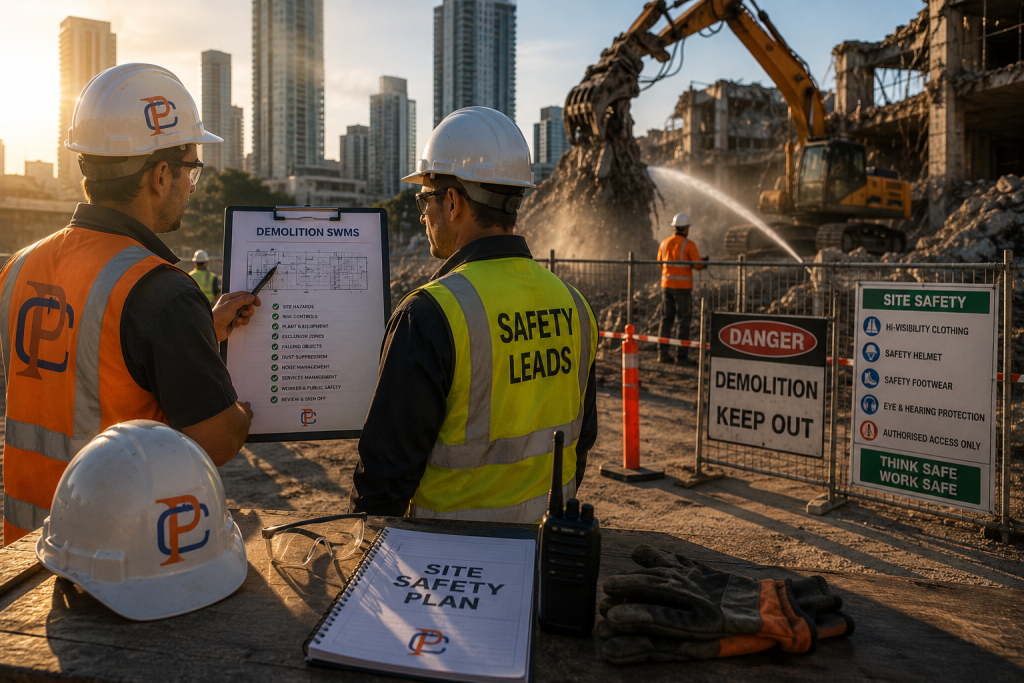
A competent contractor should be able to explain the proposed demolition methodology, site-specific hazards and the controls required to manage them.
Depending on the project, this can include:
- Safe Work Method Statements (SWMS)
- exclusion zones
- site security and controlled access
- plant and machinery movements
- falling-object controls
- dust suppression
- protection of adjoining structures
- noise management
- worker and public safety
- management of existing services.
SafeWork NSW describes demolition as dangerous and high-risk construction work. That is a pretty good reason not to treat safety paperwork as a box-ticking exercise.
The planning needs to translate into what actually happens on site.
4. Ask About Asbestos Before Demolition Begins
This is particularly important when dealing with older properties.
Asbestos-containing materials were extensively used in Australian construction, and demolition can turn a previously contained material into a serious risk if it is disturbed without appropriate identification and controls.
Ideally, asbestos should be identified and dealt with before demolition starts, rather than becoming an unpleasant and potentially expensive surprise halfway through the project.
Asbestos removal also has its own licensing requirements in NSW.
A Class A asbestos removal licence permits removal of friable and non-friable asbestos. A Class B licence permits removal of non-friable asbestos and asbestos-contaminated dust or debris associated with that non-friable material, subject to the relevant NSW requirements.
This means appointing a demolition contractor doesn’t automatically mean every type of asbestos removal is covered.
Before appointing a contractor, establish who is responsible for identifying suspected asbestos, arranging removal, managing notifications where required and obtaining any necessary clearance before demolition continues.
For a closer look at this issue, see our articles on Asbestos Removal in Newcastle and Asbestos Safety: Living Safely in a Post-Asbestos Environment.
5. Site Management Can Make or Break the Project
The actual demolition may be the most visible part of the job, but site management is what keeps everything moving.
Consider a Newcastle demolition project with excavators, trucks entering and leaving the property, neighbouring businesses or homes, waste stockpiles, disconnected services and several contractors working to a construction schedule.
Someone needs to control all of that.
Ask who will manage the project day-to-day and how communication will work between the demolition team, client, builder, developer and other contractors.
Good site management should account for machinery movements, deliveries, waste removal, dust, noise, security, neighbouring properties and changing site conditions.
It becomes even more important when demolition forms the first stage of a larger construction or civil project.
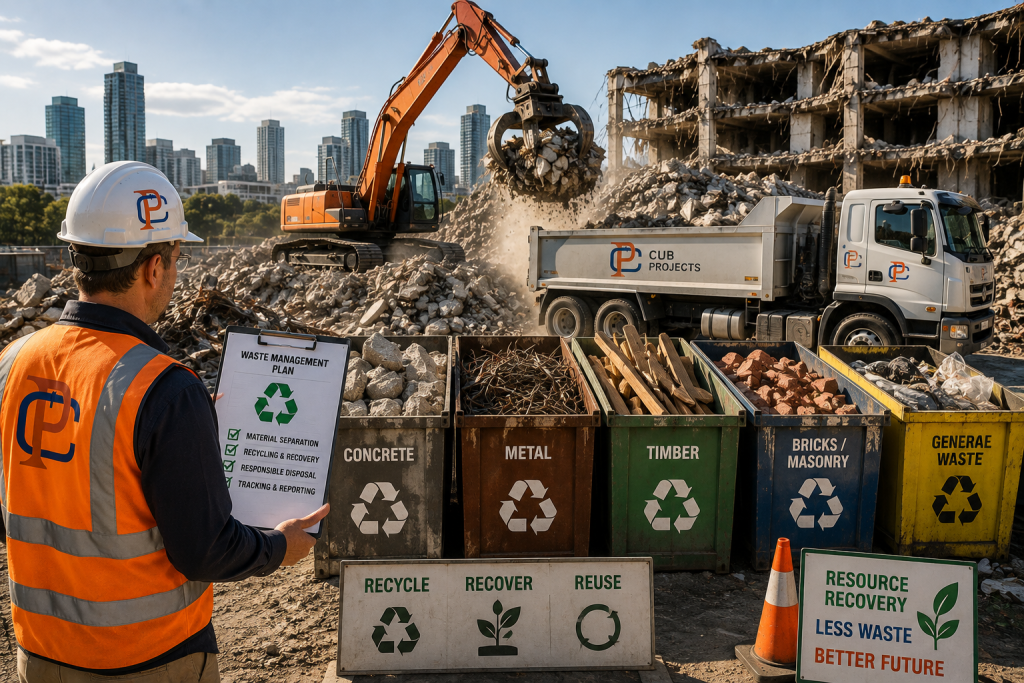
6. What Happens to the Demolition Waste?
A demolition project isn’t finished when the building hits the ground.
There can be tonnes of material still sitting on the site.
Concrete, steel, timber, bricks and other materials may have opportunities for separation, recycling or recovery. Hazardous materials require appropriate handling and disposal.
Ask the contractor how waste will be separated, transported and disposed of, and what documentation will be available where required.
CUB Projects has previously looked at this subject in detail in Sustainable Practices and Innovations in Demolition Waste Management, including the role of concrete recycling, metals recovery, timber reuse and better material separation.
For developers in particular, waste management shouldn’t be an afterthought. It needs to be considered when planning the demolition and assessing the real cost of the project.
7. Compare the Scope, Not Just the Quote
This is where apparently cheap demolition quotes can become expensive.
Two quotes showing very different bottom-line figures may not be quoting the same job.
Before comparing prices, check what each contractor has actually included.
Does the quotation cover site establishment? Machinery? Demolition? Waste transport and disposal? Site clearing? Hazardous-material management? Protection of neighbouring property? Final clean-up?
And just as importantly, what has been excluded?
If asbestos is discovered, who pays? If additional waste is generated, how is it charged? What condition will the site be left in?
A detailed scope gives you something meaningful to compare.
A cheap number with a long list of exclusions doesn’t.
Questions to Ask Before Appointing a Demolition Contractor
Before selecting from the demolition contractors servicing Newcastle, it is worth asking:
- What demolition licence do you hold, and is it appropriate for this project?
- Have you completed projects similar to this one?
- Who will supervise and manage the demolition site?
- How will asbestos and other hazardous materials be identified and managed?
- What safety controls will be established before demolition starts?
- What exactly is included and excluded from the quotation?
- How will demolition waste be separated, recycled or disposed of?
- How will neighbouring properties and the public be protected?
- What happens if unexpected structural issues or hazardous materials are discovered?
- What condition will the site be left in when the work is completed?
The answers can tell you considerably more than the quote alone.
Choosing Demolition Contractors in Newcastle
Choosing the right demolition contractor comes down to capability, planning and confidence that the job can be completed safely and properly.
Look beyond the price.
Check licensing. Look at relevant project experience. Understand who will manage the site. Ask about asbestos before work starts. Find out where the demolition waste goes. And make sure you understand precisely what is included in the quotation.
A well-managed demolition creates a clean starting point for whatever comes next.
A poorly managed one can create delays, additional costs and problems that follow the project long after the building has gone.
If you are planning residential, commercial or industrial demolition in Newcastle or the Hunter Region, speak with CUB Projects about the site, the proposed works and the demolition requirements before the project gets underway.
Learn more about CUB Projects’ demolition services in Newcastle.
Frequently Asked Questions About Demolition Contractors in Newcastle
1. Do demolition contractors in Newcastle need to be licensed?
Certain demolition work in NSW requires a demolition licence. SafeWork NSW has restricted and unrestricted demolition licence categories, with the appropriate licence depending on factors including the structure and demolition methodology. For licensed demolition work, the contractor must operate within the conditions and scope of the relevant licence.
2. How can I check whether a demolition contractor is properly licensed?
Ask the contractor for its demolition licence details and verify them through the NSW Government’s public licence register. Where asbestos removal forms part of the project, the relevant asbestos removal licence should also be checked.
3. Should a property be checked for asbestos before demolition?
Potential asbestos-containing materials should be identified and appropriately managed before they are disturbed. This is particularly important with older buildings. Finding asbestos after demolition has commenced can create safety issues, additional costs and project delays.
4. Can every demolition contractor remove asbestos?
No. Asbestos removal is separately regulated in NSW. The type and condition of asbestos determine the licence required. A demolition contractor therefore needs either the appropriate asbestos removal capability or arrangements with suitably licensed specialists.
5. What should be included in a demolition quote?
A useful demolition quotation should clearly define the scope of work and identify inclusions and exclusions. Depending on the project, this may include site establishment, demolition, machinery, waste handling and transport, disposal charges, hazardous-material management, site clearing and the condition in which the site will be handed back.
6. How should I compare demolition contractors in Newcastle?
Compare more than price. Consider the contractor’s licence, relevant project experience, safety systems, site-management capability, approach to asbestos and hazardous materials, waste-management process and exactly what is included in the proposed scope. The cheapest quotation isn’t necessarily the lowest-cost project once exclusions and variations are taken into account.
References and Sources
SafeWork NSW, Unrestricted Demolition Licence
https://www.safework.nsw.gov.au/licences-and-registrations/licences/unrestricted-demolition-licence
SafeWork NSW, Restricted Demolition Licence
https://www.safework.nsw.gov.au/licences-and-registrations/licences/restricted-demolition-licence
SafeWork NSW, Class A Asbestos Removal Licence
https://www.safework.nsw.gov.au/licences-and-registrations/licences/class-a-asbestos-removal-licence
SafeWork NSW, Class B Asbestos Removal Licence
https://www.safework.nsw.gov.au/licences-and-registrations/licences/class-b-asbestos-removal-licence
CUB Projects, From Wrecking Balls to Precision Implosions: Navigating Demolition Methods, Regulations and Sustainability in Australia
https://cubprojects.com.au/navigating-demolition-australia/
CUB Projects, Sustainable Practices and Innovations in Demolition Waste Management
https://cubprojects.com.au/demolition-waste-management/
CUB Projects, Asbestos Removal in Newcastle
https://cubprojects.com.au/asbestos-removal-in-newcastle/
CUB Projects, Asbestos Safety: Living Safely in a Post-Asbestos Environment
https://cubprojects.com.au/asbestos-safety/